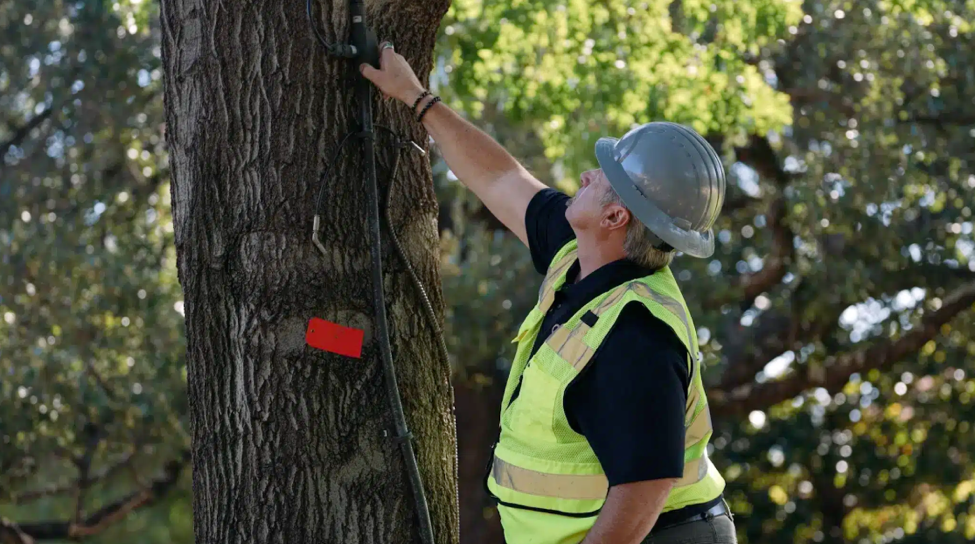

A branch drops on a windless afternoon. Nobody saw it coming. The tree looked fine yesterday, and the week before that, and probably for the past few years. What actually happened was a slow cellular shutdown at the attachment point, invisible from the ground. The tree finally gave up supporting dead weight. Tree inspections catch this sort of thing because trained eyes recognise the early biochemical warnings that most people miss entirely.
Reaction Wood Problems
Trees on slopes grow differently. The stressed side develops denser wood to hold the lean. Sounds good, except this compression wood is brittle compared to normal timber. Flexing isn’t really its strong point. A tree stays angled for years, looking stable enough, then snaps without warning. The compression wood just reached its breaking point. Arborists examine growth rings like medical scans, spotting where stress has been building quietly.
Roots That Strangle
Sometimes a root wraps back around and chokes its own trunk. Planting too deep causes this. So do roots that circled in the nursery pot and never got straightened out. You won’t see the usual root flare at ground level. Just trunk disappearing into soil. Beneath the surface, that looped root is cutting off nutrient flow like a tourniquet. The tree might grow beautifully for ages before the strangulation catches up.
Bark Sandwiched Between Branches
Close-growing branches trap bark between them instead of fusing properly. It’s a false joint. Imagine gluing wood together with newspaper in the middle. Looks solid until you put weight on it. Heavy foliage when wet, fruit load, ice in winter—any of these can peel the branches apart. The failure seems sudden but the weakness was built in from the start.
What Borers Actually Destroy
People think borer damage is mostly cosmetic. Little holes in the bark, some sawdust, no big deal. The real damage happens inside where borers tunnel through the layer that moves sugars down to the roots. Cut enough of those supply lines and the roots starve. Meanwhile the canopy looks completely healthy because leaves are still photosynthesising. Root decline happens quietly over seasons. By the time leaves start dropping, there’s not much root system left to save. Tree inspections spot this disconnection before the reserves run out.
Lightning Strikes Linger
Lightning doesn’t always kill trees outright. The electrical charge boils moisture in the wood instantly. Steam explosions fracture the internal structure. Surface damage might heal over. Those internal cracks stay put. Years pass. Then mechanical stress hits at exactly the wrong angle and the branch fails along those hidden fracture lines. Nobody connects an old lightning scar to a failure that happens much later.
Desperate Shoot Clusters
Dense shoots sprouting along the trunk look vigorous. They’re not. This is epicormic growth, which means the tree is panicking. Something has gone wrong with either the canopy or the root system, and the tree is trying to compensate. These shoots attach weakly and break off easily. More importantly, they’re a distress signal dressed up as healthy growth. Most people see bushy new shoots and think the tree is thriving.
Different Fungi Mean Different Things
Bracket fungi on the trunk tell a different story than mushrooms at the base. Some fungi only grow on wood that’s already dead. Others actively kill living tissue as they spread. Honey fungus travels through soil, attacking root systems while the canopy shows barely any symptoms. Tree inspections identify the specific fungal species because that determines whether you’re dealing with surface issues or impending structural collapse. The type of fungus matters as much as its presence.
Conclusion
Trees talk through cellular changes and growth patterns that happen well before obvious damage appears. Tree inspections translate these early warnings by examining what’s happening beneath bark and below ground. Catching problems early versus dealing with emergency removals usually comes down to spotting stress that looks normal to most observers. Trees fail in predictable ways once you understand how their biology responds to damage and stress. That’s the difference between staying ahead of problems and reacting after they’ve already happened.